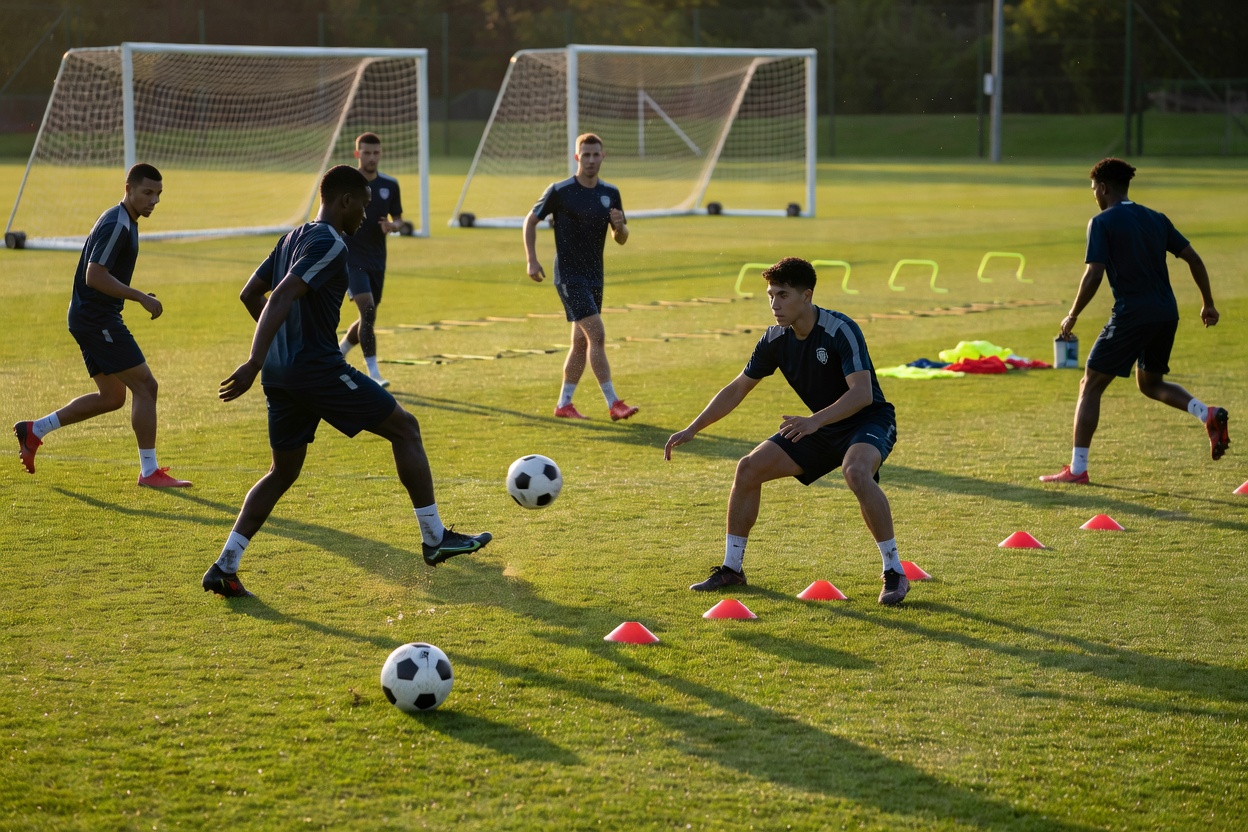
Player development is a changing process, not a ladder with identical steps for everyone. A useful view considers what a player can do, what they understand, how they respond to challenge and what support surrounds them. Current performance is valuable information, but it cannot perfectly predict future achievement.
Four connected areas of growth
Technical development concerns actions with and around the ball: receiving, passing, carrying, turning, striking and defending. Tactical understanding concerns reading the game—recognising space, teammates, opponents and changing situations. These areas are connected. A player’s touch may help them act quickly, but decisions also depend on what they have noticed and the options available.
Physical development includes movement, coordination, strength and the changing body. Growth and maturation do not happen at the same pace for every young person. Players who mature earlier may temporarily have physical advantages; that is not proof of superior long-term potential. Thoughtful coaching avoids reducing ability to size, speed or a single match outcome and adapts activity to the person in front of it.
Psychological and social skills matter too. Confidence, attention, communication, emotional regulation and teamwork can influence how players experience training. These are not fixed personality scores. Players can learn to communicate, reflect and ask for help within respectful, age-appropriate environments.
Use evidence, not a single snapshot
Development conversations can draw on several kinds of evidence: training observations, match performance, specific technical objectives, tactical understanding and the player’s own reflection. Each offers a partial view. A match may show how someone responds to pressure; a training task may offer more repetition; a conversation can reveal what the player noticed. Combining perspectives is more useful than treating one trial or selection decision as a complete verdict.
Feedback should be specific and constructive. Instead of labelling a player “good” or “not ready,” describe an observable action, ask what they saw and agree on one next step. Individual development plans can record a small number of meaningful objectives. The plan should be revisited: priorities can change as a player learns, grows or moves into a different role.
Reviews that give players a voice
A useful review meeting is a conversation, not simply a scorecard. Invite the player to identify something they have learned, a situation they find difficult and an area they want to explore. A coach can add observations and make the next objective clear. Families may contribute context, but the player’s own perspective should remain central in an age-appropriate way.
Objectives work best when they describe an action within a player’s influence. Examples include checking over a shoulder before receiving, trying both feet in a suitable practice, or communicating early when defending as a pair. Goals should be realistic, revisited and linked to practice. Avoid creating so many targets that a player cannot remember what matters.
Progression and transitions
Moving between age groups, teams or levels can change demands: training intensity, tactical detail, travel, competition and social relationships may all shift. A transition can be exciting and unsettling at the same time. Clear communication helps players understand expectations, who to approach and what support is available. Coaches can make a change more manageable by checking how the player is adapting, rather than assuming that a new team or status automatically solves every challenge.
The move from academy football toward senior football is only one possible transition, and opportunities vary. Players may continue in community, school, college, regional, recreational or other football environments. These settings can offer worthwhile competition, friendships, learning and enjoyment. A change in pathway is not a failure; it may simply reflect evolving interests, needs or circumstances.
People and context shape the journey
Coaches influence practice and feedback. Families can offer steady encouragement and practical support without making football the only measure of a young person. Education provides knowledge and choices beyond sport. The wider environment includes teammates, facilities, travel, opportunity and wellbeing. When these factors are considered together, it becomes easier to discuss development honestly rather than attributing every result to effort or talent alone.
Enjoyment is not a guarantee of achievement, but it matters in its own right. Players benefit from room to try different roles, develop at different rates and keep a balanced identity. Rest, appropriate challenge and constructive relationships can support a healthier experience. Where medical or psychological concerns arise, seek appropriately qualified professionals; this guide is educational, not clinical advice.
Player-development review checklist
- Can the player describe one recent learning moment?
- Are the next objectives specific, age-appropriate and within the player’s influence?
- Have technical and tactical observations both been considered?
- Is feedback based on more than one match or trial snapshot?
- Has the player had a chance to raise questions or concerns?
- Are school, rest, relationships and enjoyment still part of the conversation?
- Is a pathway transition being explained clearly and without guarantees?
Keep expectations realistic
Talent identification is uncertain. A player’s current level reflects experience, opportunity, growth, confidence and context, among other factors. No review system can remove that uncertainty or promise a professional contract. Families and coaches can help by focusing on learning, keeping multiple options open and treating selection as one decision at one moment—not a prediction of a young person’s whole future.
When reviewing a programme, ask how often players receive feedback, whether objectives are revisited, how physical growth is considered and what alternative opportunities exist. Ask what happens when a player is not selected or needs a break. Answers reveal how an organisation treats development beyond its most visible successes.
Related field guides
Explore academy structures, compare coaching methods and read about education and wellbeing.
Start a development conversation
We welcome thoughtful questions about progress, player voice and pathways.
Contact the journal